Improve Your Posture: How to Exercise for a Healthy Spine
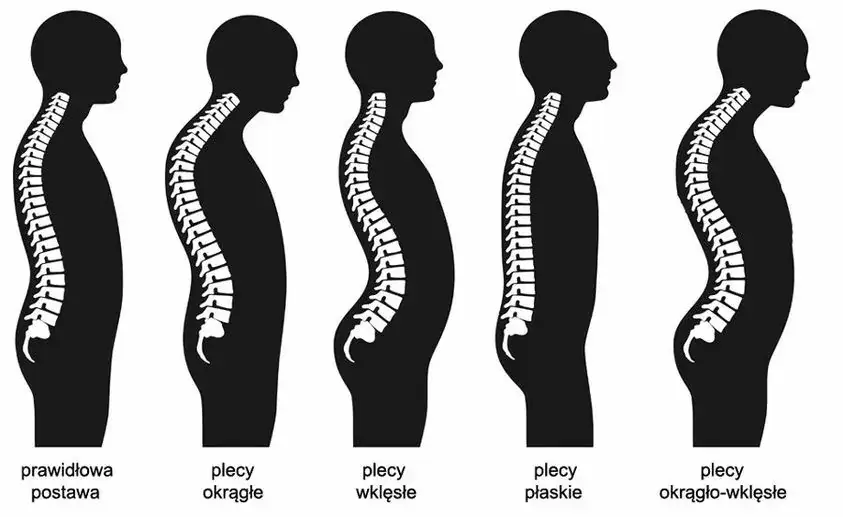
 Types of postural defects visible in a person's side profile.Improving body posture is one of the most common reasons people start exercising, especially when they experience back pain or spinal discomfort. Importantly, this isn't just an issue for older adults or those who are physically inactive. Increasingly, young people, regular gym-goers, and even amateur athletes struggle with these problems.Many people assume that because they exercise, their spine "should be healthy". Unfortunately, the opposite is often true. Poorly chosen workouts, lack of movement control, and ignoring basic biomechanics can worsen posture issues instead of resolving them. According to the World Health Organization, back pain is one of the leading causes of disability in adults.The good news is that the spine responds very well to appropriate movement. However, you need to know how to exercise and what to avoid.* * ## Where Do Posture Problems Come From?Poor body posture doesn't appear overnight. It's the result of long-term habits and the body's adaptation to your lifestyle.The most common causes of spinal problems include:- hours of sitting at a desk or in a car,- frequent use of phones and computers in a hunched position,- lack of control over pelvic and torso alignment,- weak glutes and deep core muscles,- overly tight chest and hip flexors,- training focused solely on physique.Your body always adapts to what you do most often. If you spend most of your day sitting, and your workout lasts an hour a few times a week, then sitting will have a greater impact on your posture than your exercises. Therefore, your training should counteract these adaptations, not reinforce them. * ## Improving Posture Isn't Just 'Standing Up Straight'One of the most common myths is the belief that good posture means constantly 'straightening up'. In reality, posture is an automatic body alignment, not a conscious effort.If:- stabilizing muscles are weak,- the pelvis isn't controlled,- shoulders are rounded forward,- the chest is stiff,then attempting to 'straighten up' will be temporary and often leads to excessive tension.Good posture is a result of balance, not stiffness. Your body should naturally align itself in an optimal position, without constant vigilance. * ## The Foundation of a Healthy Spine: StabilizationThe spine doesn't like complete rigidity or a lack of control. It needs a stable base, which is provided by the deep torso muscles, commonly known as the core.Their role is to:- maintain a neutral spinal position,- protect against overloads,- transfer force between the upper and lower body,- provide stabilization during limb movement.Contrary to popular trends, core training isn't about hundreds of sit-ups or 'burning' muscles. What's most important is control of movement and breathing.Among the most effective exercises are:- plank performed with full control,- dead bug,- bird dog,- anti-rotational exercises,- stabilization in asymmetrical positions.If you feel tension primarily in your lower back during these exercises, it indicates a lack of control, not a 'weak core'. * ## You Need to Strengthen Your Back, Not Just Stretch It – Improving PosturePeople with rounded backs often focus solely on stretching their chest. While this can be helpful, it usually doesn't solve the underlying problem.The main causes of slouching are:- weak back muscles,- lack of scapular control,- a dominance of pushing movements over pulling movements.If your training primarily consists of pressing, push-ups, and 'chest machines', but lacks rows and upper back exercises, your posture will worsen.Posture-improving workouts should regularly include:- various rowing variations,- exercises teaching scapular retraction and stabilization,- controlled lat pulldowns,- exercises strengthening the rear deltoids.The goal isn't maximum weight, but conscious movement execution and maintaining a neutral spine position. * ## Glutes as Spinal ProtectionOne of the most underestimated elements in the context of back health is the glutes. Their weakness leads to pelvic alignment disturbances, which directly affects the lumbar spine.When the glutes don't function correctly:- the pelvis tilts anteriorly,- the lower back takes over stabilization,- the risk of overload and pain increases.Strong glutes:- stabilize the pelvis,- take pressure off the spine,- improve movement patterns,- reduce tension in the lower back.Key exercises include:- glute bridges and hip thrusts,- deadlifts,- split squats and lunges,- squats performed with control.If you feel tension predominantly in your back, not your glutes, during these exercises, it indicates a problem with technique or stabilization. * ## Mobility – Needed, But Smartly AppliedStretching is often overrated. By itself, it won't improve posture if not accompanied by strengthening and movement control.Mobility makes sense when it:- addresses genuinely restricted structures,- is combined with active stabilization,- improves movement quality in training.Most often, it's worth working on:- chest mobility,- hip flexors,- thoracic spine rotation.Conversely, aggressive lower back stretching, deep forward bends, or 'loosening everything' without a plan often produces the opposite of the desired effect. * ## Improving Posture – What Should Your Workout Look Like?A workout supporting spinal health doesn't have to be complicated or long. Its logical structure is key.Example workout structure:- core stabilization exercise,- hip-dominant movement (squat or hip hinge),- back strengthening exercise,- supplementary exercises and mobility.Duration:- approximately 45–60 minutes.Frequency:- 2–4 workouts per week are perfectly sufficient.The most important thing is that each exercise is performed consciously, with control over spinal position and breathing. * ## The Most Common Mistake: Avoiding MovementMany people, experiencing back pain, give up training for fear of worsening their condition. This is one of the most harmful myths.Lack of movement:- weakens stabilizing muscles,- worsens body control,- increases stiffness,- often intensifies pain.A well-chosen workout:- reduces pain,- improves spinal function,- increases quality of life,- allows a return to normal activity. * *## SummaryA healthy spine and good posture are the result of long-term work, either on your own or with a personal trainer, not just one exercise or a temporary 'straightening up'.The most important elements are:- a stable core,- strong back and glutes,- movement control,- sensible mobility,- training adapted to your lifestyle.If you want to improve your posture, get rid of back pain, and train without fear for your spine, a well-chosen plan and proper technique are crucial.By working individually, you can tailor your training to support your health, not undermine it.👉 If you live in Wrocław and want a professional approach, personal training tailored to your posture and lifestyle is the fastest path to lasting results.
Related articles

Strength Training for Women Over 40: Health & Vitality
Wondering how to maintain your vitality? Strength training for women over 40 is key to unlocking lasting health, strength, and a youthful appearance, even as you face age-related challenges.

Muscle Building Diet: Optimal Nutrition Principles for Growth
An effective muscle-building diet is fundamental to success. Learn how calorie surplus, macronutrients, and meal timing impact your progress and ultimately shape your physique.